
How a curve changes a station
A station is built from hard lines, platforms, columns, signage, and the architecture of getting somewhere. What sits inside that structure can soften it, direct it, and quietly determine how people feel moving through it.
A shape that takes on the architecture
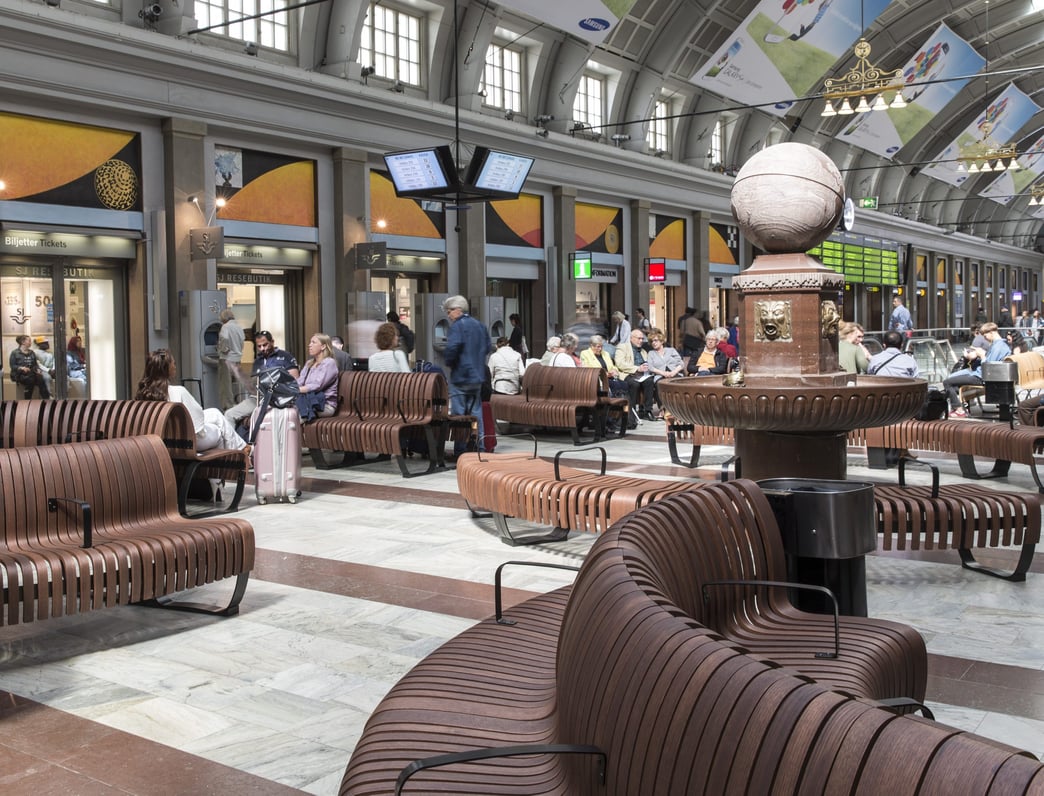
Stations rarely repeat themselves. Each one carries its own geometry, curved concourses, irregular columns, platforms that taper or widen without warning. A modular solution built around curvature doesn't impose a fixed footprint onto that geometry; it follows it. The same solution can trace the radius of a concourse, wrap a column, or step around a structural constraint that would otherwise interrupt the flow of people through the space.This is what it means for seating to become part of a space. The curve isn't decorative; it's how the solution reads the architecture and adapts to it, so the seating appears to have grown from the room rather than been placed into it.
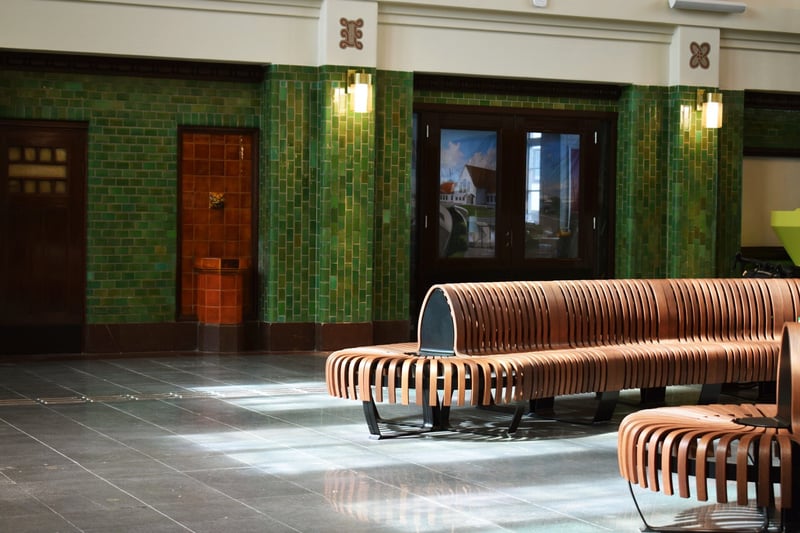
Sundsvall Central station
Shaping how people move
A curved line does something a row of fixed seats cannot: it directs the eye and the body without a sign or a barrier. Positioned along a concourse, it can draw passengers toward retail, food service, or a platform entrance simply by the direction it leans. Positioned around a column or a structural edge, it can absorb a dead zone and turn it into usable space.
The same logic shapes attention. A curve angled toward a shopfront gives a seated passenger a clear sightline into it, increasing visibility into retail spaces. The form is doing the directing; no signage is required.
Holding stillness inside motion
A station is built for rushed movement, yet the moment someone sits, the room slows around them. Wood holds warmth and offers tactility in an otherwise sterile and functional environment. The curve completes that effect: no hard edge, no straight line interrupting the configuration.
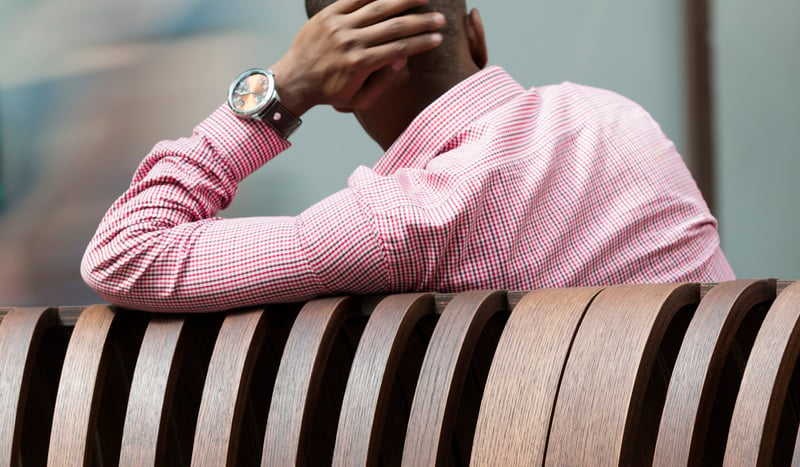
Stockholm Central station
Density that follows the curve
Because the solution is modular and seamless, curvature doesn't cost capacity. Removing the gaps between individual seats increases the number of seats per metre of floor, even as the line bends around a column or follows an uneven concourse wall. A curved configuration near a food and beverage area can hold tabletops within the same footprint, giving passengers somewhere to sit when the cafés are full, within sightline of the departure boards, and measurably increasing takeaway sales in at least one case.
One identity, many shapes
Because the same modular logic adapts to different architectures, a single product series can give an entire rail network a consistent identity, the same material, the same line, the same way of meeting a space, while still resolving differently in every station it appears in.
Related insights
.jpg?width=253&height=150&name=GreenFurniture_shopping%20center_main_2%20(3).jpg)
Retail consumer experience: Evolving expectations and natural spaces
The retail landscape has undergone a radical transformation. Shopping centres, once purely commercial destinations, are now evolving into multi-sensory, social environments, places where people go ...
Improving the airport passenger experience
Airports today are no longer mere points of departure and arrival. They have become destinations themselves. As the first and last impression of a passenger journey, they shape how we feel about the ...
Supplier spotlight: Meet QTech
The collaboration between Circalle and Qtech formally began in June 2025, when Qtech began manufacturing the Nova C series. Based in Anderstorp in southern Sweden and operating within a strong ...